Blind annotation: the protocol
Pre-registration
This page describes the annotation rubric before a single annotation was produced. It
is published in a commit that precedes data/annotations.json, and the repository history
attests to that. Results will be appended at the end of the page, with nothing above them
rewritten.
The question left open
The extended corpus measured a null result — persistence does not differ between emotional registers, ×3.04 versus ×2.90, \(p = 0.53\) — but it also exposed the flaw in its own protocol. Membership of a Wikipedia category is a noisy proxy for the register: "Lil Tay" sits in a hoax category because of a hoax about her death, while the attention paid to that article is a celebrity's attention.
Label noise introduces no directional bias: it attracts any gap towards zero. The null result is therefore consistent with two readings the data cannot separate:
- there is no persistence gap between registers;
- there is one, diluted by approximate labelling.
Annotating the register by hand, subject by subject, settles it — and nothing else does. If the gap reappears among correctly labelled subjects, dilution was the explanation; if it stays absent, the absence of an effect was.
What is annotated
All 440 subjects of the data/catalogue.json manifest, without exception. Annotating a
chosen subset would reopen precisely the selection bias that the category-derived corpus had
closed.
Annotation does not modify the corpus: it adds a column to it. The pool remains the one the categories produced.
The question put to each subject
What would mobilise public attention on this article?
Not what the article is about, but which emotion would carry its consultation.
| Register | Definition | Role in the model |
|---|---|---|
accusation |
a wrong, a threat or a deception attributed to someone: scandal, conspiracy, corruption, atrocity, manipulation | high emotional charge \(\alpha\) |
discovery |
a discovery, an exploration or an achievement: scientific result, space mission, distinction | low \(\alpha\) |
neither |
neither of those: entertainment, celebrity, ordinary institution, catalogue entry, technical concept | outside the comparison |
The third label is what does the work. It removes from the corpus those subjects a category captured for thematic reasons without their audience belonging to the register — and the rate at which it is used directly measures the label noise the extended corpus could only diagnose.
Five tie-breaking rules
Fixed before reading, so that borderline cases are not decided one at a time:
- A work of fiction about a scandal is
neither. Its audience is a fiction audience. This holds for novels, films, series and video games, whatever their subject. - A person is coded by what makes them notable according to their lede: a science
laureate is
discovery, a figure under accusation isaccusation, a celebrity isneither. - An atrocity, a massacre or an attack is
accusation. The register is that of wrong and threat, regardless of whether a formal accusation exists. - A catalogue object or an instrument with no announcement stays
discoveryif its notability rests on what it allowed to be observed, and becomesneitherif it is merely one technical entry among thousands. - An abstract concept naming the wrong itself — "disinformation", "political corruption"
— is
accusation. Rule 1 does not apply: it is not a work.
Two ancillary dimensions
- the kind of subject — event, person, organisation, work, concept, object. It allows a later check that the comparison does not pit events against concepts, the confound the choice of categories sought to avoid without being able to measure it;
- the confidence, binary. Uncertain subjects are not discarded — discarding on sight of the result is exactly what pre-registration forbids — but they support a sensitivity check, and each carries a written justification.
Blindness, and what it is worth
The annotation must owe nothing to the result it serves to measure. Three provisions contribute, and what each guarantees must be stated.
| Provision | What it guarantees |
|---|---|
| the rubric is written before the data | verifiable by a third party in the git history |
| the annotator's input is frozen and fingerprinted | data/extracts.json, whose SHA-256 is recorded in the annotation file: what was read is known |
| pageview series are not loaded during annotation | a property of the process, not a cryptographic guarantee — it is declared, not proven |
The material is the article's lede — its first section, plain text, truncated to 600 characters. That is what a reader sees before deciding whether to read on, hence the right granularity for coding what would mobilise their attention.
What blindness does not cover
A residual contamination, named. Six subjects were quoted with their lift on the extended
corpus page — Lil Tay, Watch Dogs, Million Dollar Extreme, The Capture, Mossack Fonseca,
Illuminati (game). The annotator knows them. They are listed in
ide.annotation.CONTAMINATED, they are annotated like the rest, and the analysis is repeated
without them as a sensitivity check.
A single annotator. There is no inter-rater agreement, hence no measure of coding reliability. This work corrects label noise; it does not establish that the rubric would be applied identically by someone else. That is the dispositif's principal limitation, and the rubric written above is what makes it at least replicable.
Partly lifted — see Replication
The corpus has since been recoded twice, blind, under the identical rubric: Fleiss' \(\kappa\) of 0.921. The rubric is therefore reproducible. What remains — that three instances of one model are not three human judges — is taken up below.
Knowledge of the aggregate result. The annotator knows the previous measurement was null. No provision neutralises that; the direction of any resulting bias is undetermined.
What will be measured
In this order, fixed in advance:
- the confusion matrix category × annotated register — the label noise rate, which is a result in itself;
- persistence — median lift of detected regime changes, compared between annotated registers by a Mann-Whitney test. This is the primary test;
- the switching rate, with the same traffic controls as on the extended corpus: stratification and matching;
- three sensitivity checks: without the contaminated subjects, without the uncertain annotations, and with subject kind controlled.
No subject will be removed on sight of its result. Subjects with no detected change will be reported as such.
Results
The question is settled: the gap was not diluted, it does not exist
The switching-rate gap disappears entirely once the label is corrected: 8.6 % versus 2.7 % (\(p = 0.012\)) becomes 4.8 % versus 5.1 %, odds ratio 0.93, \(p = 1.00\). Persistence remains null — ×3.04 versus ×2.90, \(p = 0.90\) — and the test retains the power to detect a gap of the magnitude the pilot corpus announced.
Label noise was massive
Two subjects in five belong to neither register, and agreement between category and annotation reaches only 59.5 %. The extended corpus's conjecture is confirmed, and its magnitude exceeds what it supposed.
And the annotation exposes a design flaw
Correctly labelled, the two registers barely cover the same kinds of subject: concepts and events on one side, objects and people on the other. A comparison built on thematic categories therefore also compares kinds of object.
1. Label noise, measured
| Category | n | coded accusation | coded discovery | coded neither |
|---|---|---|---|---|
| accusation | 220 | 147 (66.8 %) | 3 (1.4 %) | 70 (31.8 %) |
| discovery | 220 | 0 (0.0 %) | 115 (52.3 %) | 105 (47.7 %) |
Overall agreement: 262/440 = 59.5 %. Register outright reversed: 3 subjects.
The noise is asymmetric, for a reason of construction: the discovery register drew its numbers from catalogues of celestial objects, the vast majority of which are technical entries with no audience. The ten-thousand-byte substance filter did not suffice there.
But outright reversal is near zero. The category errs by capturing subjects outside the register, almost never by assigning the wrong register — exactly the profile of noise that dilutes without biasing, as the extended corpus had supposed.
2. The switching-rate gap evaporates
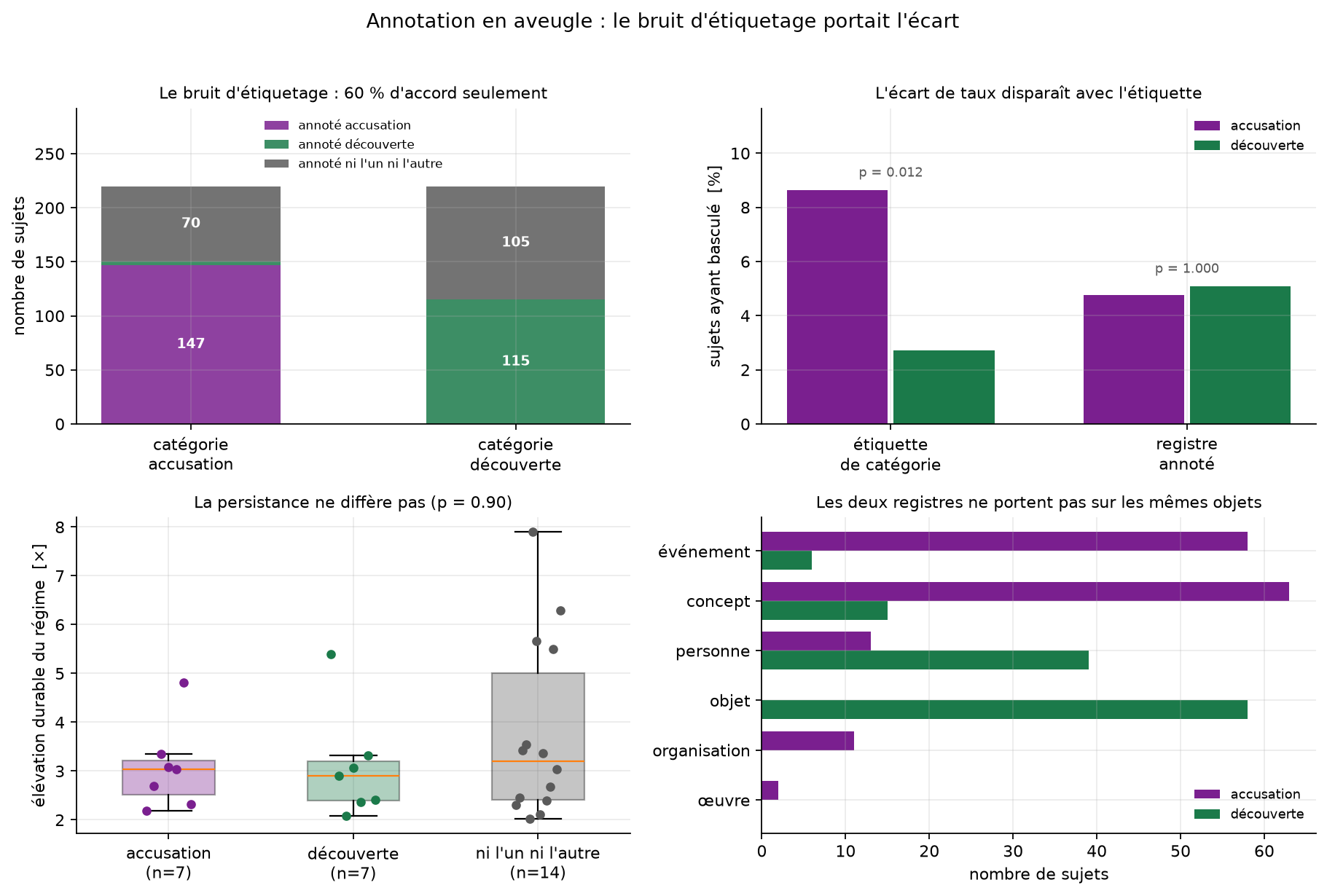
Label noise; the disappearance of the rate gap once the label is corrected; persistence by annotated register; and the design flaw the annotation reveals. Figure regenerated by notebook 12.
| Label | accusation | discovery | odds ratio | p |
|---|---|---|---|---|
| category | 19/220 = 8.6 % | 6/220 = 2.7 % | 3.37 | 0.012 |
| annotation | 7/147 = 4.8 % | 6/118 = 5.1 % | 0.93 | 1.000 |
| (neither) | 12/175 = 6.9 % |
The odds ratio does not shrink: it vanishes, and even reverses very slightly.
The most telling detail is the last row. Discarded subjects switch at 6.9 %, that is, more often than either register. They were not inert observations: they were what carried the gap attributed to the accusation register. Of the corpus's five largest lifts, four are coded neither — Lil Tay, Watch Dogs, Million Dollar Extreme, The Capture. Exactly the cases the extended corpus had flagged as suspect.
The audience imbalance was itself an effect of the labelling. Median traffic goes from 39 versus 11 views/day (\(p = 5\times10^{-14}\)) to 36 versus 26.5 (\(p = 2.6\times10^{-3}\)): catalogue entries with no audience were inflating the discovery register. Both of the extended corpus's controls confirm the absence of a gap — stratum ≥ 47 views/day, OR = 0.45 (\(p = 0.32\)); 116 traffic-matched pairs, McNemar \(p = 1.00\).
3. Persistence stays null — and the test could have concluded
| Corpus | accusation | discovery | p |
|---|---|---|---|
| pilot, 24 hand-picked subjects | ×9.20 (n = 8) | ×2.90 (n = 6) | 0.081 |
| extended, category label | ×3.04 (n = 21) | ×2.90 (n = 7) | 0.533 |
| extended, annotated register | ×3.04 (n = 7) | ×2.90 (n = 7) | 0.902 |
| without contaminated subjects | ×2.87 (n = 6) | ×2.90 (n = 7) | 0.945 |
| without uncertain annotations | ×3.06 (n = 6) | ×2.90 (n = 5) | 0.931 |
| comparable traffic stratum | ×2.69 (n = 5) | ×2.90 (n = 7) | 0.876 |
Fourteen observations, seven a side. This must be said before it is objected — but a Mann-Whitney test at seven against seven is not blind:
| Ranks of overlap | p |
|---|---|
| 0 — complete separation | 0.0006 |
| 2 | 0.0048 |
| 4 | 0.040 |
| 5 | 0.140 |
The pilot corpus announced interquartile ranges of [4.0, 14.9] versus [2.7, 3.2], that is, nearly disjoint. A gap of that magnitude would have been detected here. The null result is therefore not a mere want of power.
The question the extended corpus left open is settled: the gap was not diluted by the labelling, it does not exist.
4. What the annotation reveals about the design
This is the finding neither the pilot nor the extended corpus could make, for want of a reliable label.
| Kind of subject | accusation | discovery | neither |
|---|---|---|---|
| event | 58 | 6 | 1 |
| concept | 63 | 15 | 21 |
| person | 13 | 39 | 12 |
| object | 0 | 58 | 109 |
| organisation | 11 | 0 | 13 |
| work | 2 | 0 | 19 |
The accusation register is made of concepts and events; the discovery register, of objects and people. Only one kind appears on both sides in sufficient number — people, 23.1 % versus 7.7 %, \(p = 0.16\) — and it yields nothing conclusive. Concepts never switch: 0 of 63 and 0 of 15.
The consequence goes beyond this corpus. A register comparison built on thematic categories also compares, and perhaps chiefly, kinds of object. An encyclopaedic concept — "Corruption in Mexico" — does not have the attention dynamics of a dated event, independently of any emotional charge. The extended corpus named this confound without being able to measure it; here it is measured, and it is severe.
This is a limitation of the design, not of the result: it does not resurrect the gap, it indicates what a fourth protocol should control.
5. A note on identification
One fit in twenty-eight now passes every check, including the observability guard added after the extended corpus. It concerns "Watch Dogs (video game)" — a subject coded neither. Parameter identification therefore remains, in practice, out of reach on this kind of data.
Replication: two independent coders
The rubric is reproducible — Fleiss' κ = 0.921
The corpus was recoded by two readers independent of the context, under the identical rubric, from the same material presented in a different order and without the category label. Pairwise agreement: 0.903 · 0.917 · 0.944. Unanimity on 92.3 % of subjects. On the Landis–Koch scale, \(\kappa > 0.80\) reads as "almost perfect agreement".
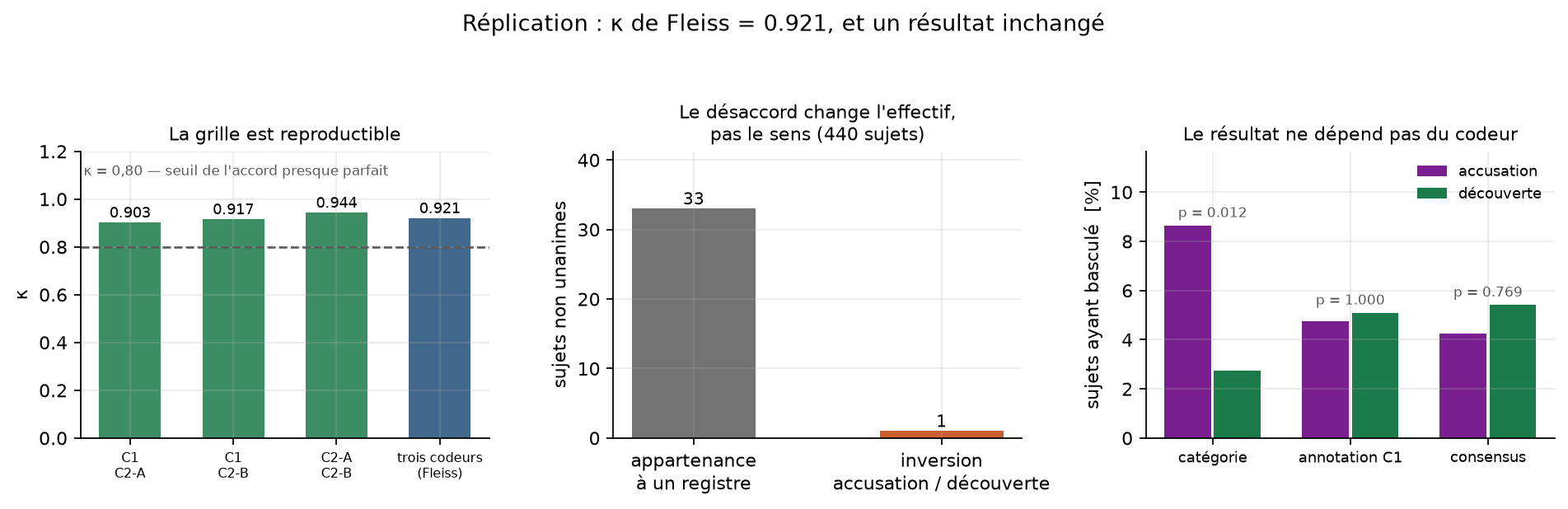
Chance-corrected agreements; the nature of the thirty-four disagreements; and the result under all three labellings. Figure regenerated by notebook 12.
The margins, then the subjects
| Coder | accusation | discovery | neither |
|---|---|---|---|
| C1 — initial | 147 | 118 | 175 |
| C2-A | 140 | 114 | 186 |
| C2-B | 141 | 109 | 190 |
The marginal distributions are already close, but that is not enough: two coders can produce the same counts on different subjects. Chance-corrected agreement settles it, and it matters here — on a corpus where 40 % fall under one label, raw agreement would flatter.
| Pair | raw agreement | Cohen's \(\kappa\) |
|---|---|---|
| C1 vs C2-A | 93.6 % | 0.903 |
| C1 vs C2-B | 94.5 % | 0.917 |
| C2-A vs C2-B | 96.4 % | 0.944 |
| all three (Fleiss) | — | 0.921 |
The disagreement falls in the right place
Thirty-four subjects are not unanimous. Their breakdown is this section's structural result:
| Nature of the disagreement | subjects |
|---|---|
membership of a register (accusation or discovery against neither) |
33 |
| swap of the two compared registers | 1 |
One subject out of 440 has one coder saying "accusation" where another says "discovery". The rubric's residual ambiguity therefore varies the comparison's sample sizes, not its sense — the least damaging form of imprecision one could hope for.
The contested cases are interpretable: stars whose lede does not say whether their notability rests on a discovery, physics apparatus with no associated announcement, and a few affairs whose lede does not report the accusation. Rule 4 — the catalogue object — is the one leaving most latitude, and that is where a version 1.1 of the rubric should focus.
The result under consensus coding
| Label | accusation | discovery | odds ratio | p |
|---|---|---|---|---|
| category | 8.6 % | 2.7 % | 3.37 | 0.012 |
| annotation C1 | 4.8 % | 5.1 % | 0.93 | 1.000 |
| consensus of three | 4.3 % | 5.4 % | 0.78 | 0.769 |
And persistence: ×3.06 (n = 6) versus ×2.90 (n = 7), \(p = 0.836\).
Both results are unchanged. The initial coding was not a special case.
What this agreement does not measure
The three coders are instances of the same language model. The agreement therefore measures the reproducibility of the rubric — the fact that a fresh reading of the same instructions, with no access to the first coding or to the results, returns the same labels. It does not measure agreement between independent human judges, and it necessarily overstates it, since instances of one model share their priors.
The caveat calling for multiple human coders therefore stands in full. What has changed: we now know the written instructions suffice to produce a stable coding, which makes the work replicable by a third party rather than merely consultable.
What this changes for the project
Four measurements have been made, and none distinguishes the emotional registers: the amplification rate (calibration), persistence on the pilot then the extended corpus (regimes, extended corpus), and the switching rate. The last rescuing hypothesis — dilution by approximate labelling — is eliminated.
The emotional-charge mechanism \(\alpha\) remains without empirical support, and no longer for want of looking. If that mechanism exists, it does not show in the aggregate attention dynamics of an encyclopaedia.
What survives is intact and never depended on the register: dated-switch detection works, dates and amplitudes are robust, and they remain the instrument of observation proposed in the memorandum.
Open leads
- ~~Have the same corpus annotated by a second coder, also blind, and publish Cohen's \(\kappa\).~~ → done, with two coders rather than one: Fleiss' \(\kappa\) of 0.921, and an unchanged result under consensus coding. What remains is a coding by human annotators: three instances of one model share their priors, and therefore overstate agreement.
- Match on subject kind as well as on traffic, at corpus construction time. Comparing events with events and people with people is now a measured requirement, not a theoretical precaution.
- Lower the detection threshold by aggregating weekly. Twenty-eight switches across 440 subjects leave the primary test at seven observations per register; that is the remaining limiting factor.
- Look for the effect somewhere other than aggregate attention dynamics. Three quantities have been tested without result; the fourth lead should not be a fourth measurement of the same object.
Implementation: ide.annotation · Script: scripts/fetch_extracts.py ·
extended corpus · roadmap