Regime changes: reaching the disinformation that installs itself
Detection works, and covers the blind spot
14 regime changes detected across the corpus, on the right dates — the Benalla affair on 20 July 2018, the Pegasus revelations in July 2021, the LIGO announcement in February 2016. And crucially in the subjects that peak calibration missed: QAnon, COVID-19 misinformation, vaccine hesitancy.
Identification fails
0 of the 14 yields usable parameters. The median residual scatter of the real series is 0.63, whereas the relative uncertainty on \(\gamma\alpha/\lambda\) already reaches 77 % at 0.15. Parameters are refused rather than reported with an illusory error bar.
Since disproved — the persistence gap does not replicate
The ×9.2 versus ×2.9 gap reported below was tested on 440 category-derived subjects: it becomes ×3.04 versus ×2.90, \(p = 0.53\). It was an artefact of hand-selecting the twenty-four subjects of this pilot corpus, which contained the best-known conspiracy theories. The section is kept as written, with this warning.
Blind annotation of the register then eliminated the last rescuing hypothesis: the gap was not diluted by approximate labelling, it does not exist.
And a theoretical limitation dominates both
The identifiability of \(\gamma\alpha/\lambda\) from a regime change depends on the assumed saturation form. Under logistic saturation it does not exist: two parameter triples with ratios of 5.0 and 1.7 produce exactly the same curve. The ratio is therefore not a quantity the data determine.
The problem peak calibration left open
Eleven of the twenty-four corpus subjects had yielded no exploitable episode — and these were the archetypal cases. Their attention does not form a spike followed by decay: it shifts level and settles. The rolling baseline follows that plateau, so the prominence criterion is never met.
A model of polarisation that only measures passing flare-ups does not reach its object.
Why the peak estimator cannot be reused
Peak identification rested on two slopes: a rise at \(\gamma\alpha - \lambda\), a decay at \(\lambda\).
In an installed regime the decay does not exist. The system sits at its fixed point, where by definition \(\gamma\alpha\,\sigma(V^*) = \lambda\): the plateau level alone says nothing, and there is no second slope.
The information lies in the shape of the transition, which traverses the whole saturation range and constrains all three parameters at once.
An exact identification, and its fragility
Setting \(y = \dot W/W\) and \(x = W^2\), an exact rearrangement of the equation yields a form linear in three coefficients:
hence \(\lambda = C/B\) and \(\gamma\alpha/\lambda = 1 + AB/C\). The regression recovers all three parameters to machine precision, including for \(\rho = 40\).
Yet it is unusable as such: \(y\) appears both as the response and inside the regressor \(-xy\), and it must be obtained by differentiating noisy data. At 10 % multiplicative noise, the estimate of \(\rho\) collapsed from 5.0 to 1.7.
The retained estimator therefore uses no derivative: it integrates the equation and fits the trajectory in log space, the linear form serving only as initialisation.
The fit is performed on the observed series \(V = V_{\text{before}} + W\), not on the excess alone. The difference is decisive: early in the transition, \(W\) is a small difference between two noisy quantities — precisely the phase that constrains \(\gamma\alpha - \lambda\).
The theoretical limitation
Under the model's saturation, \(\sigma = 1/(1+(W/W_{\text{sat}})^2)\), the three parameters shape the curve in three distinct ways and are separable.
Under logistic saturation, \(\sigma = 1 - W/W_{\text{sat}}\), the equation becomes
The trajectory then depends on only two combinations of the three parameters. The ratio is structurally unidentifiable there, and no measurement precision will change that.
The identifiability of \(\gamma\alpha/\lambda\) from a regime change is not a property of the data: it is an assumption about the saturation form.
Both forms are therefore fitted side by side, and RegimeShift.is_form_identified flags cases
where the data do not decide.
Detection: what works
Binary segmentation on the logarithms — audience evolves multiplicatively, and a doubling must count as much at a thousand as at a hundred thousand views a day. The split that most reduces the quadratic cost is retained if it exceeds a penalty, which avoids fixing a number of change points in advance.
Three validations before calling something a regime change:
| Criterion | Purpose |
|---|---|
| sustained over 180 days | this is what separates a regime from a peak: a peak falls back |
| lift of at least ×2 | a level shift, not a fluctuation |
| prior regime ≥ 50 views/day | there must be a prior regime for it to change; a series going from 2 to 300 views describes an article that has just been written |
Three further precautions proved necessary in practice:
- weekly periodicity is removed first. It is a systematic effect of 20–30 % amplitude, and residual scatter directly drives the uncertainty;
- the change-point position is not reliable for delimiting the fitting window: mean-shift segmentation places the break near the middle of a gradual rise. The onset is therefore located separately, at the first durable crossing of 5 % of the lift;
- a gradual rise is cut into a staircase by the segmentation. Breaks belonging to one staircase describe a single regime change and are deduplicated.
Results
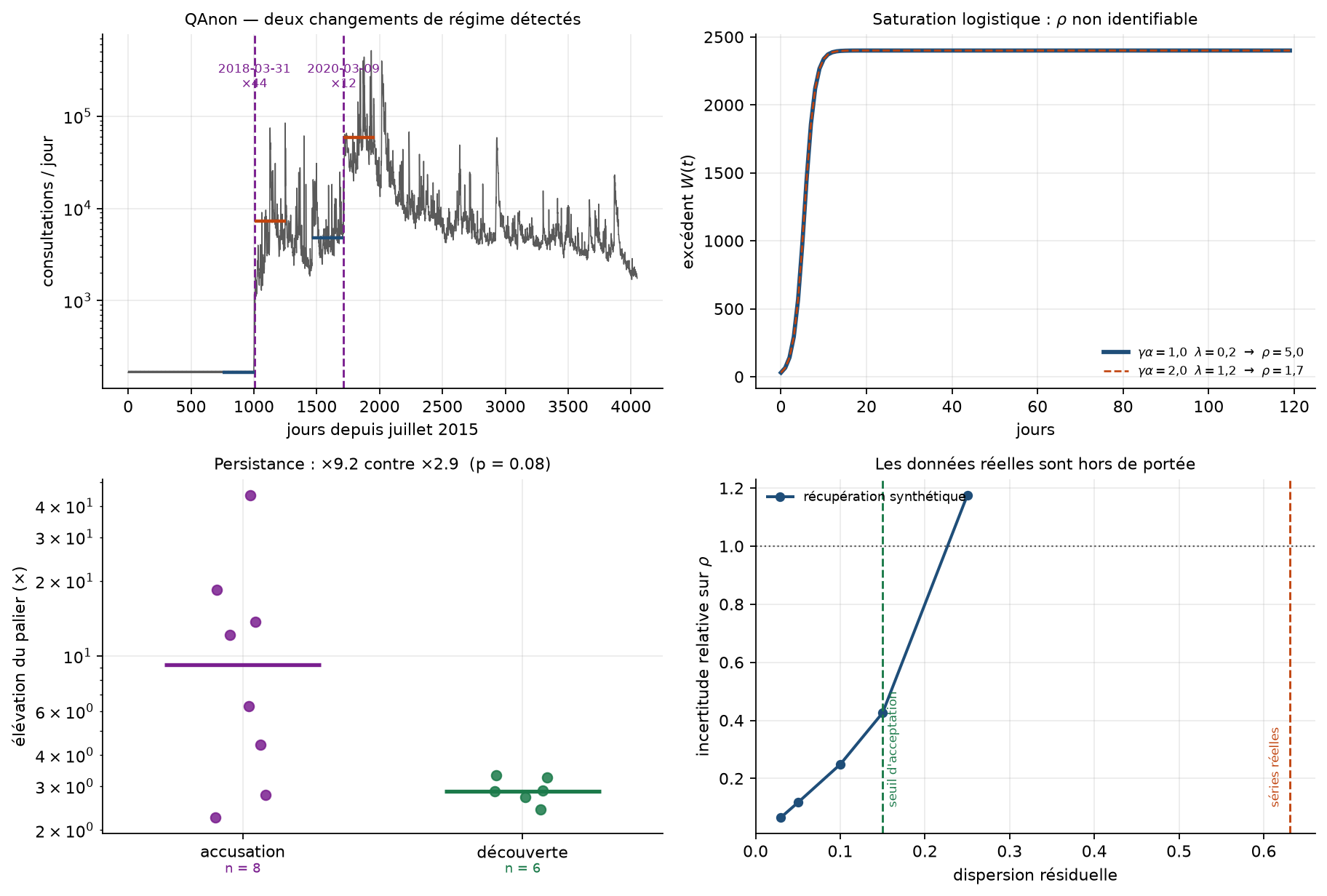
QAnon and its two dated switches; the demonstration of unidentifiability under logistic saturation; persistence by emotional register; and where the real series sit relative to attainable precision. Figure regenerated by notebook 10.
The dates are right
The most telling validation: with no date supplied to it, detection recovers datable events.
| Subject | Detected date | Event | Lift |
|---|---|---|---|
| QAnon | 31 March 2018 | emergence of the movement | ×44 |
| Pizzagate | 16 March 2020 | pandemic-era revival | ×18 |
| Gilets jaunes | 3 May 2019 | — | ×14 |
| QAnon | 9 March 2020 | pandemic switch | ×12 |
| Pegasus | 17 July 2021 | Pegasus Project revelations | ×4.4 |
| Benalla affair | 20 July 2018 | the affair breaks | ×2.8 |
| OSIRIS-REx | 12 June 2016 | — | ×3.3 |
| LIGO | 9 January 2016 | leaks preceding the announcement | ×3.2 |
| James Webb telescope | 27 September 2021 | run-up to launch | ×2.9 |
| Gravitational waves | 1 February 2016 | detection announcement | ×2.7 |
| Event Horizon Telescope | 1 April 2019 | first black hole image | ×2.4 |
No false positives on stationary noise, no peak accepted, no article creation retained.
A difference between registers, for the first time in the project
Peak calibration found no difference between accusation content and scientific announcements: the amplification ratio was indistinguishable, and the point estimate even went the wrong way.
Persistence says otherwise:
| Register | n | median lift | IQR |
|---|---|---|---|
| accusation | 8 | ×9.2 | [4.0, 14.9] |
| discovery | 6 | ×2.9 | [2.7, 3.2] |
Mann-Whitney: \(p = 0.081\).
This is not conclusive — fourteen observations, threshold not crossed — and a further caveat applies: the discovery-register changes all sit just above the detection threshold (×2.4 to ×3.3), suggesting some are slow-decaying peaks rather than genuine regimes.
But the direction is the one the model predicts, the gap is clear, and it concerns a quantity the project had not yet measured:
It is not the amplification rate that distinguishes emotional registers, it is how long attention stays captured.
This conclusion is disproved
Across 440 subjects the gap becomes ×3.04 versus ×2.90 (\(p = 0.53\)). The wording above is kept on record: it illustrates what a hand-picked selection of twenty-four subjects can suggest.
Identification fails, and why
None of the fourteen changes yields usable parameters.
This is not an implementation defect: recovery is exact on a clean trajectory, including for \(\rho = 40\). It is a mismatch between a three-parameter model and the real noise of attention series, which carry successive media bumps superimposed on the trend.
| residual scatter | relative uncertainty on \(\rho\) |
|---|---|
| 0.05 | 24 % |
| 0.10 | 53 % |
| 0.15 — acceptance threshold | 77 % |
| 0.25 | 135 % |
| 0.63 — real series | out of reach |
The refusal is a deliberate choice. An earlier version of the module tolerated a scatter of 0.30 and produced values such as \(\lambda = 4.4\) per day — a collective memory of five hours — or \(\rho = 139\). Those figures had the appearance of results.
What this changes for the memorandum
Recommendation 2 capped \(\gamma\alpha/\lambda\). That formulation assumed the ratio measurable. It is neither measurable on installed regimes, nor independent of an assumption about the saturation form.
By contrast, two quantities are well measured: the date of the switch and the lift of the plateau. A regulatory framework anchored to those would be enforceable where a threshold on \(\rho\) is not, and it would address what a regulator actually seeks to establish: not the speed of a flare-up, but how long a false belief stays installed.
They do not distinguish emotional registers, however: verification on 440 subjects and then blind annotation established that. They are instruments of observation, not proof of a mechanism.
Open leads
- Reduce the model rather than improve the fit. Two parameters identifiable without a form assumption — initial growth rate and plateau level — are worth more than three of which one is not determined by the data.
- A less noisy observable. Daily pageview scatter is irreducible; weekly series, or a measure of exposure rather than consultation, would change the order of magnitude.
- ~~Extend the corpus to persistence.~~ → done, and the gap failed to replicate (extended corpus), then was eliminated for good by blind annotation of the register.
- Check that "discovery" regimes really are regimes by lengthening the required sustain period.
Implementation: ide.regime · Notebook:
10 — Regime change ·
peak calibration · roadmap