Exposure finally measured, no longer estimated
The form test's impasse is lifted
On the examination measure rather than on clicks, cascade and click budget separate perfectly: \(z = -158\) to \(-412\) under cascade, \(z = -1.03\) under budget whatever the budget. What clicks conflated, display settles.
On Baidu-ULTR, cascade is refuted
Examination below a click is more frequent, not less — 0.221 against 0.136 at rank nine, \(z = +8.4\) to \(+10.9\) depending on threshold. A cascade would make it zero.
And this repository's published figure is revised
\(\eta_{\text{examination}} = 0.882 \pm 0.046\) over 143 documents, against \(\eta_{\text{click}} = 1.085 \pm 0.093\) over 55. Estimating through clicks overstates decay by 23 %, because a click conflates examination with attractiveness.
The power law is the worst of three fits
On the measured curve: \(R^2 = 0.72\) with 42 % maximum error, against \(0.96\) for geometric decay and \(0.99\) for a screen-fold model. At rank two it predicts 0.47 where measurement gives 0.88.
What these columns contain
The form test ended on an impasse — a click budget mimics a cascade — and a
lead: Baidu-ULTR publishes displayed_time, serp_height and slipoff_count_after_click, which
this repository had never read.
displayed_time is populated and informative: 1.6 % zeros at rank one, 92 % at rank twelve. It is
a direct measure of what was shown, where the rest of this repository only observed what was
clicked.
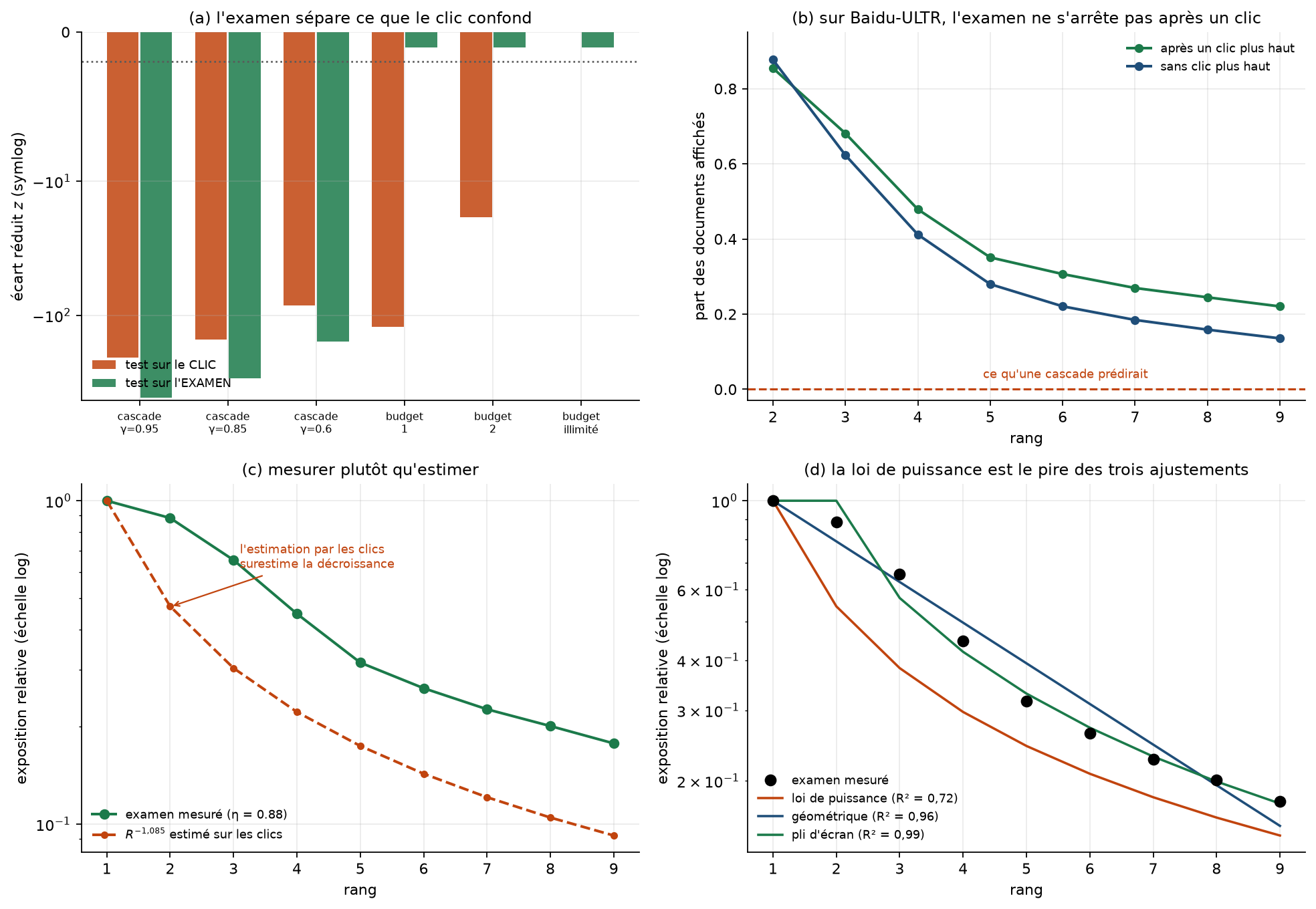
Cascade / budget discrimination on examination; examination after a click on Baidu-ULTR; measured versus estimated exposure; and the three forms fitted to the measured curve. Figure regenerated by notebook 23.
1. The control, first
The repository's rule: apply any protocol to data whose answer is known before carrying it to real data.
| Simulated log | \(z\) on clicks | \(z\) on examination |
|---|---|---|
| cascade, \(\gamma = 0.95\) | −206.7 | −412.2 |
| cascade, \(\gamma = 0.85\) | −151.5 | −295.4 |
| cascade, \(\gamma = 0.60\) | −84.2 | −157.8 |
| position, budget = 1 | −121.8 | −1.03 |
| position, budget = 2 | −18.6 | −1.03 |
| position, unlimited budget | 0.00 | −1.03 |
On clicks, cascade and budget are conflated: two massive rejections no threshold separates. On examination, separation is total. The previous chapter's identification limit falls as soon as a measure of what was shown is available.
2. On Baidu-ULTR
| Impression threshold | \(z\) on examination | \(p\) | Cells |
|---|---|---|---|
| 2 | +10.87 | \(1.7 \times 10^{-27}\) | 1,736 |
| 5 | +9.08 | \(1.1 \times 10^{-19}\) | 527 |
| 10 | +8.86 | \(7.8 \times 10^{-19}\) | 269 |
| 20 | +8.38 | \(5.2 \times 10^{-17}\) | 165 |
The examination measure is also far better resourced than clicks: 1,736 cells against 780, because a document is shown far more often than it is clicked.
| Rank | Examination after a click | Without | Gap |
|---|---|---|---|
| 2 | 0.855 | 0.877 | −0.022 |
| 4 | 0.479 | 0.412 | +0.067 |
| 6 | 0.307 | 0.221 | +0.086 |
| 9 | 0.221 | 0.136 | +0.085 |
Under cascade, examination after a click should be zero. It is higher, and the gap sets in from rank three. This is the heterogeneity confounder measured directly: a reader who clicks is an engaged reader, who scrolls further.
What displayed_time measures, and what it does not
A positive display time attests that the document was shown, not that it was looked at — a proxy, better than a click but imperfect. It may also be recorded on return from a click: a reader who clicks, comes back, and continues. That reading remains incompatible with a strict cascade, which assumes the session ended.
3. Measuring rather than estimating
| Method | \(\hat\eta\) | Documents |
|---|---|---|
| fixed effects on clicks | 1.085 ± 0.093 | 55 |
| fixed effects on examination | 0.882 ± 0.046 | 143 |
| Rank | Measured examination | Estimated \(R^{-1.085}\) | Error |
|---|---|---|---|
| 2 | 0.884 | 0.471 | −47 % |
| 4 | 0.447 | 0.222 | −50 % |
| 9 | 0.178 | 0.092 | −48 % |
Why the two differ. A click is the product of examination and attractiveness. Since attractiveness also declines with rank — a platform puts its best documents on top — the severity fitted on clicks absorbs both.
This is the same confounder served rank identified between the aggregate fit (1.49) and fixed effects (1.10). Fixed effects remove part of it, not all: a document does not keep the same attractiveness at every rank, which the literature calls trust bias. The examination measure does not depend on attractiveness at all.
4. The form, at last testable
| Fit on the measured curve | \(R^2\) | Max error |
|---|---|---|
| power law (\(\eta = 0.88\)) | 0.7215 | 42 % |
| geometric (\(\gamma = 0.79\)) | 0.9621 | 24 % |
| screen fold (fold at rank 2, tail \(\eta = 1.07\)) | 0.9879 | 13 % |
The measured curve does not decay smoothly: it holds through rank two, drops sharply from three to five, then flattens.
The explanation I gave for it is false
I saw in it the signature of a screen threshold, and attributed to serp_height the rank
at which it falls. On verification, rank explains better than
cumulative height (McFadden \(R^2\) 0.082 against 0.057) and pixels add only 0.0007. The
finding — this is not a power law — holds; the mechanical explanation falls.
What this section does not claim
Three forms fitted on nine points is not model selection: the screen fold has two free parameters against one for the others, and wins for that reason as much as for its shape. What is solid is more modest and enough: the power law describes the measured curve badly, and it errs most where the standard is decided — at rank two.
5. What this changes for the data access request
A digest built on clicks alone does not suffice. One more column — the number of impressions actually displayed, per (item, rank) cell — would stop exposure being estimated at all.
That column would remove at a stroke:
- the need to estimate \(\eta\), hence the shape assumption that comes with it;
- the ambiguity between cascade and click budget;
- and the attractiveness confounder that inflates the click-based estimate by 23 %.
One column, against three problems open for six chapters. And it is less sensitive than clicks: knowing an item was displayed says less about a reader than knowing they chose it.
Reproducibility
The raw log is not versioned. The digest now carries examination counts per cell — impressions, impressions displayed, and both split by whether a click occurred above. The result is recomputed identically, zero gap at all four thresholds, which a test verifies.
Reservations
displayed_time measures a display, not a gaze. The measure therefore overstates exposure, by
an amount this repository cannot quantify.
The slice used remains a slice: 524,164 documents out of Baidu-ULTR's 1.2 billion sessions, and a search results page is not a news feed. The 0.88 holds for that surface.
~~slipoff_count_after_click and media_type were not exploited.~~ →
done: the first refutes cascade a second time, by a recorded
fact rather than a test; the second establishes that a rich format above removes 8.4 points of
examination from what follows, at equal rank and comparable height — a figure
chapter 25 brings down to 6 % once the item is held fixed.
Implementation: ide.exposure.examination_counts, ide.logs.upstream_dependence_test ·
Notebook: 23 — Measured exposure ·
the form test · logs that record the rank