Whoever chooses the catalogue chooses the index
The level of the index has no absolute meaning
The same corpus scores 0.50 over twenty-six sections and 0.92 over three. At a floor of 0.40, the share of the population below the threshold goes from 13.7 % to 1.5 %: the same floor becomes decorative without a single impression changing.
The ordering, however, holds — up to a point
Going from twenty-six sections to twelve changes nothing in the ranking of readers (\(\rho = 1.000\)). At six it still holds (\(0.911\)). At three it is destroyed (\(-0.09\)): the index then stops ranking, not merely measuring.
And 'exposed diversity' does not exist in the singular
Sections and tone — the corpus's two labelling axes — agree only at \(\rho = +0.16\). Among the quarter most diverse in sections, 23.8 % are also in the quarter most diverse in tone, where independence would give 25 %.
A caveat never quantified
Since day one the index has carried the same caveat:
Discretising into viewpoints is a political choice. Whoever defines the modalities defines the index. Cutting the space of opinions into 4, 40 or 400 categories changes the measured value, and that cut is not a neutral technical act.
True, and it says nothing: by how much? Enough to make a floor arbitrary, or little enough for to live with? Chapter 26 finally provides the means to settle it — 58,549 real user-days, composition known section by section.
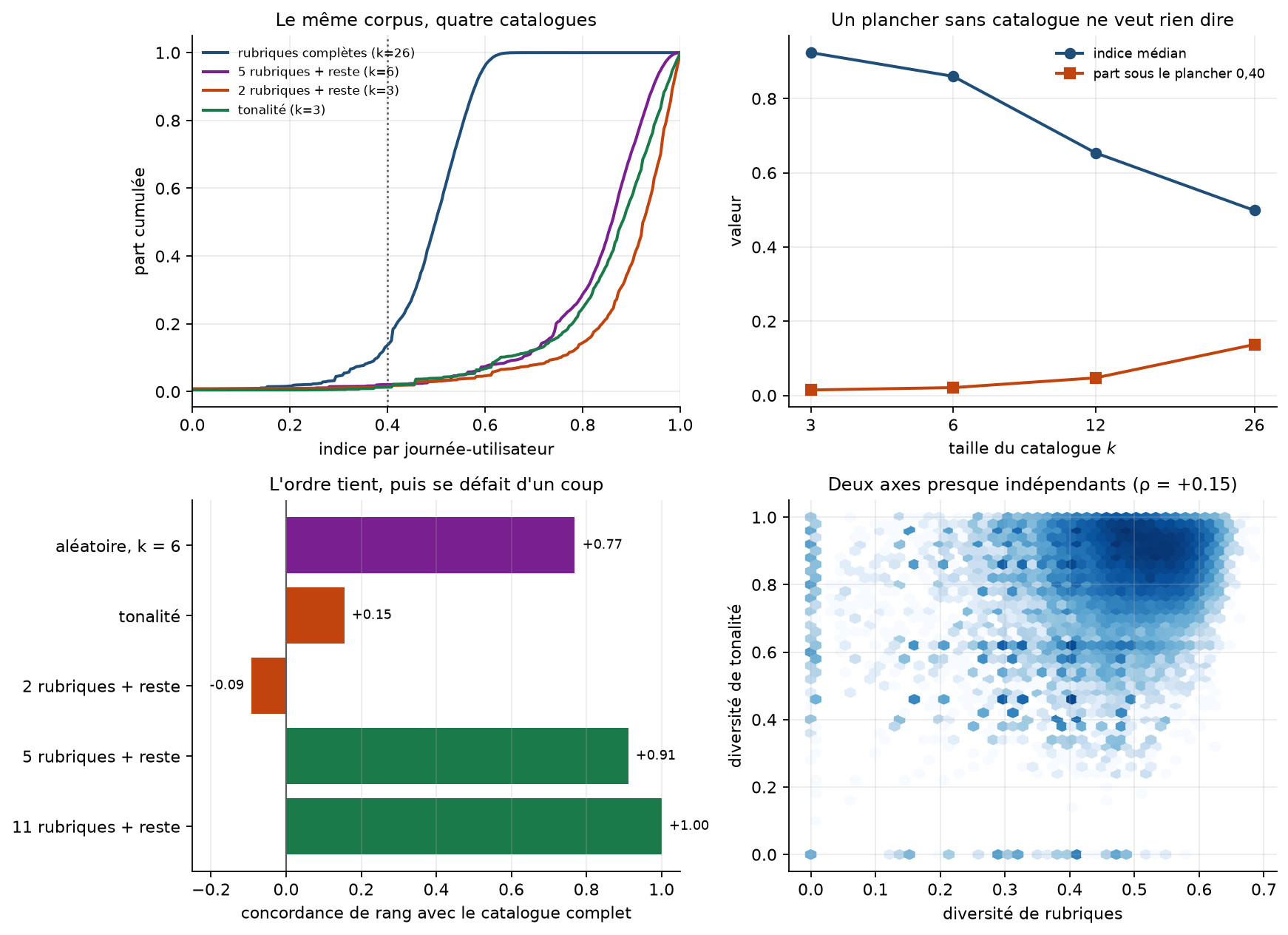
The same corpus under four catalogues, the collapse of the floor with catalogue size, the rank concordance that holds then breaks, and the independence of the two labelling axes. Figure regenerated by notebook 28.
1. Three quantities the caveat conflated
| Catalogue | \(k\) | Median index | Effective viewpoints | Below 0.40 | Below 0.50 | Rank \(\rho\) |
|---|---|---|---|---|---|---|
| full sections | 26 | 0.498 | 5.07 | 13.7 % | 50.7 % | — |
| 11 sections + rest | 12 | 0.654 | 5.07 | 4.7 % | 10.9 % | +1.000 |
| 5 sections + rest | 6 | 0.860 | 4.67 | 2.1 % | 3.0 % | +0.911 |
| 2 sections + rest | 3 | 0.924 | 2.76 | 1.5 % | 3.1 % | −0.093 |
| tone | 3 | 0.881 | 2.63 | 1.3 % | 4.0 % | +0.155 |
The level moves by half. The share below the floor is divided by nine. The ordering does not move at all — until it collapses.
2. Why the ordering holds so well, then not at all
The reason is banal and decides everything: rare sections serve almost nothing.
| Most-served sections | Share of the corpus |
|---|---|
| the top 2 | 52.1 % |
| the top 5 | 88.6 % |
| the top 11 | 99.8 % |
Merging the remaining fifteen sections merges anything at all for only one user-day in a thousand: the ranking cannot move. Dropping to six forces a merge on 64.5 % of user-days; to three, on 94.8 %. That is where the ordering comes apart.
3. A catalogue's size does not specify it
If only size mattered, any cut into six classes would match the frequency cut. Twenty random draws say otherwise:
| Grouping into 6 classes | Median index | Rank \(\rho\) |
|---|---|---|
| by frequency | 0.860 | 0.911 |
| at random | 0.682 ± 0.093 | 0.769 ± 0.098 |
Two catalogues of the same size return indices two tenths apart and rankings fourteen points of concordance apart. It is the list that must appear in the standard, not the number.
4. A section is not a viewpoint — and it can now be measured
The previous chapter stated that caveat without quantifying it. The corpus's two labelling axes allow it: the thematic section and the declared tone.
\(\rho = +0.155\). A reader may receive every section of the paper in a uniformly negative tone, or a single section across all three tones. Exposed diversity is a quantity per declared axis, not a quantity.
5. What this changes in the access request
A floor is published with its catalogue, or not at all. A regulation fixing a threshold without annexing the exact list of modalities would leave the platform free to choose its own mark.
The catalogue must carry at least half a dozen effectively served modalities. Below that the index no longer ranks: concordance with a fine catalogue falls to zero, and two platforms become incomparable even relatively.
And one must say which axis is measured. Topic, tone, political leaning: these axes do not follow from one another, and that choice weighs at least as much as the numeric threshold.
Reservations
The coarse catalogues here are obtained by grouping an existing catalogue, which is not the same as a catalogue designed as such — a cut conceived in six viewpoints would probably be better balanced than the five most-served sections plus a remainder.
The corpus is that of a single Danish newspaper. Nothing guarantees the section distribution has the same tail shape everywhere, and it is that tail which explains the stability observed up to twelve modalities.
Finally, tone is a label produced by a model, not by an editorial desk: its weak agreement with sections may owe something to its own noise.
Notebook: 28 — The catalogue · the index measured · Index