The page effect, once composition is removed
One of this repository's conclusions, corrected by a factor of three
The previous chapter measured that a rich format served higher up removes 18 % of examination from what follows. With the item held fixed, 6 % remains (RR = 0.940, 95 % CI [0.916, 0.964]). Two thirds of the published effect were composition: which queries trigger an answer box, not what the box does to the reader.
Two independent matchings agree
Same document at the same rank: 0.940. Same query at the same rank: 0.942 — on seven times fewer impressions, and establishing nothing on its own. Two designs sharing no stratum return the same figure to within two thousandths.
And the rank law this chapter was meant to bury holds
Ignoring page composition moves the index by 0.0025; using the \(1/R\) convention instead of the measured curve moves it by 0.0350. Fourteen times more. What threatens the measurement is not the page, it is not having measured.
What the previous chapter concluded
It compared enriched pages to the others at comparable rank and comparable page height, and read a gap of eight examination points on a base of 0.45. From it, a broad claim:
The exposure of an item at rank \(R\) depends on the format of what sits above it […] No law \(e(R)\) — power, geometric or otherwise — can represent it, since it does not take the page as an argument.
That claim rested on a control that was missing: the item. An answer box does not appear at random. It answers a factual question, which does not invite the same reading as an exploratory search. The measured gap could come from the format, or from what the format appears on.
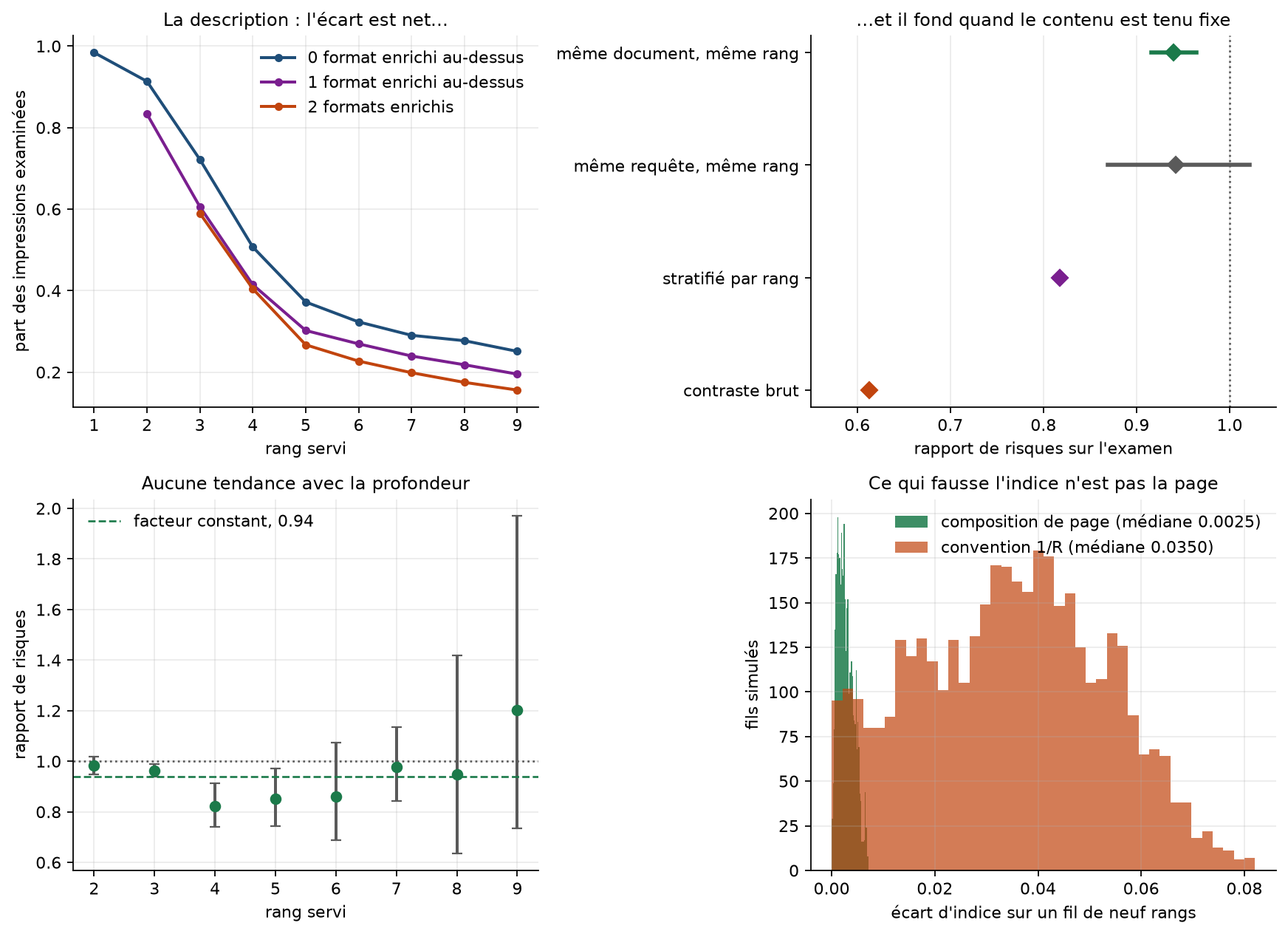
The description, the effect once the item is held fixed, its absence of trend with depth, and what ignoring the page actually costs. Figure regenerated by notebook 25.
1. The check that decides the rest
Repository rule, learnt three times the hard way: apply the protocol first to data whose answer is known.
We simulate a world where the format has no effect on examination, but where enriched pages land on systematically less-consulted items — the suspected confounder, and nothing else.
| Simulated effect | Read by stratifying on rank | Read with the item held fixed |
|---|---|---|
| 1.00 — no effect | 0.785 | 1.005 (95 % CI [0.993, 1.016]) |
| 0.90 — known effect | 0.701 | 0.896 (95 % CI [0.886, 0.907]) |
The matching passes both trials. Stratifying on rank alone fails the first: it reads a clear effect in a world that carries none — and the figure it manufactures, 0.785, is roughly the one this repository had published.
2. The measurement
| Reading | RR | 95 % CI | Impressions |
|---|---|---|---|
| raw contrast | 0.613 | — | 452,689 |
| stratified on rank | 0.817 | [0.812, 0.823] | 452,689 |
| same document, same rank | 0.940 | [0.916, 0.964] | 31,045 |
| same query, same rank | 0.942 | [0.869, 1.022] | 4,261 |
Rank by rank, no trend: the effect does not deepen with depth, and every interval overlaps. The simplest surviving hypothesis is a constant factor.
3. What ignoring the page actually costs
The claim "no law \(e(R)\) can represent it" is tested by putting a number on it. Over four thousand simulated feeds of nine ranks and four viewpoints:
| What is ignored | Median index gap | 99th percentile |
|---|---|---|
| page composition | 0.0025 | 0.0066 |
| the measurement, replaced by the \(1/R\) convention | 0.0350 | 0.0735 |
A constant factor is a rescaling, to which a normalised index is insensitive; only rank 1, which never carries anything above it, keeps the effect from vanishing altogether. That is why six points of relative risk amount to two thousandths of index.
Same order on severity: \(\eta = 0.876\) ignoring the page, \(0.854\) on the counterfactual bare page. Two hundredths.
4. What this changes
The order of priorities reverses. What must be required of a log is not first the format
served but the measurement of exposure itself — the impressions column. The format column
of the access request remains useful, because it allows this chapter to be
checked elsewhere, but it ceases to be necessary to computing the index.
And the attention discount becomes portable again. That was the real stake: if \(w_R\) depended on the page, no measurement could be written without describing every page served. It does depend on it, by 6 %, and the index moves by 0.0025.
Reservations
The item-matched design retains only 1,106 strata out of 404,478: those are documents served at the same rank in pages of differing composition, and nothing guarantees they resemble the others. The figure holds for them.
The query matching is independent and agrees, but it is seven times less populated: it establishes nothing on its own, its interval containing 1.
Grouping media_type into "ordinary" versus "enriched" remains a choice of this repository, not
a categorisation by the platform.
Finally, this chapter does not say the page has no effect — the interval of the most populated matching excludes 1. It says the effect is three times smaller than published, and that its bearing on the regulated quantity is negligible next to that of the convention it replaces.
Notebook: 25 — The page effect · format and return · measured exposure