The last two columns, and an abandoned hypothesis
Cascade refuted a second time, by a counter
slipoff_count_after_click is non-zero for 43.7 % of clicked rows and 0.5 % of the
rest. After a click, the log explicitly records that documents scrolled past: the reader came
back. Under a strict cascade, this column would always be zero.
Corrected — two thirds of this effect were composition
This chapter measured that a rich format above removes 8.4 points of examination from what follows, at equal rank and comparable page height, and concluded that the attention discount \(w_R\) was a property of the page served. The missing control was the item: with the item held fixed, 6 % remains instead of 18 %, and a simulation carrying no effect at all reproduces almost exactly the figure published here.
What follows is kept as it was published. Its correction is in the next chapter.
And a hypothesis I put forward is false
The screen fold — "exposure would be a matter of pixels, not rank" — does not hold. Rank explains better (McFadden \(R^2\) 0.082) than cumulative height (0.057), and pixels add only 0.0007 once rank is known.
What remained to be read
Measured exposure ended on two columns set aside. They do three things here: one confirms a hypothesis by an independent route, another establishes a new one, and a third — asserted confidently in the previous chapter — does not survive verification.
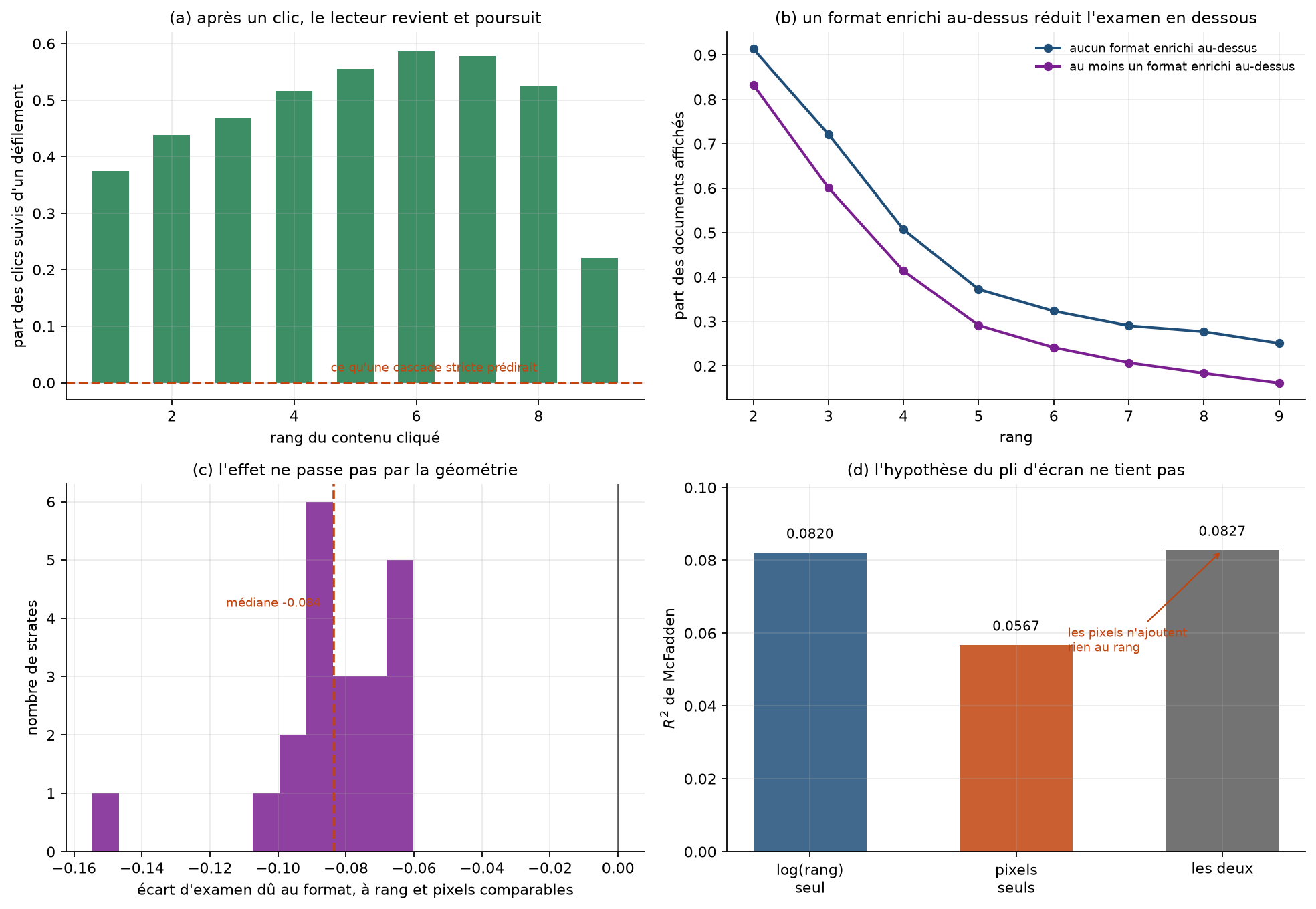
Return after a click; the effect of a rich format above; the survival of that effect once geometry is neutralised; and the screen-fold hypothesis defeated. Figure regenerated by notebook 24.
1. Return after a click, measured
The previous chapter found that examination continues below a click, and offered an explanation: "a reader who clicks, comes back, and continues". That was a hypothesis advanced to explain an unexpected sign.
slipoff_count_after_click verifies it directly: it counts documents that slipped off screen
after a click, and can only be non-zero if the reader came back.
| Rank of the clicked item | Share of clicks followed by scrolling |
|---|---|
| 1 | 0.374 |
| 3 | 0.469 |
| 6 | 0.586 |
| 8 | 0.526 |
The share grows with the depth of the click, which reads easily: a reader who had to scroll down to find something has not finished looking.
Two independent routes agree. Measured exposure refuted cascade by a statistical test on examination; this column refutes it by a recorded fact. That is the best one can ask of a refutation.
2. Format alters exposure
A rich format — answer box, image, table — is taller: 273 pixels median against 192 for a plain result. The natural hypothesis is therefore geometric: rich content on top would push what follows down the screen.
It can be tested by neutralising height — at equal rank and comparable cumulative pixels:
| Rank | Pixel band | Without rich | With rich | Gap |
|---|---|---|---|---|
| 3 | middle third | 0.800 | 0.722 | −0.078 |
| 6 | middle third | 0.367 | 0.280 | −0.087 |
| 9 | middle third | 0.266 | 0.178 | −0.088 |
Median gap across 21 strata: −0.084, all of the same sign. The effect survives once geometry is neutralised: it is not a pushing-down effect.
The remaining explanation is satisfaction: an answer box answers the question, and the reader stops descending. That is the reading the whole-page literature proposes, and the figure bears it out here.
What this takes away from any rank-only measure
The exposure of an item at rank \(R\) depends on the format of what is above it, and that dependence reduces neither to rank nor to space occupied. No law \(e(R)\) — power, geometric or otherwise — can represent it, since it does not take the page as an argument.
Two feeds of identical composition, served with different formats, do not expose the same thing.
Withdrawn — this conclusion assumed a control that was missing
The strata above hold rank and pixels fixed, but not the item. An answer box does not appear at random: it answers a factual question, which does not invite the same reading. Once the same document is compared with itself at the same rank, the gap falls to 6 % — and its bearing on the index to \(0.0025\), fourteen times less than that of the \(1/R\) convention it was meant to disqualify. → the page effect
3. A hypothesis withdrawn
The previous chapter found the measured examination curve is not a power law, and proposed a screen fold model. I wrote:
That is the signature of a screen threshold […] The
serp_heightcolumn encodes exactly the page height, hence the rank at which that threshold falls.
That was a mechanical hypothesis, and serp_height allows it to be tested.
| Model | McFadden \(R^2\) |
|---|---|
| log(rank) alone | 0.0820 |
| cumulative pixels alone | 0.0567 |
| both | 0.0827 |
Rank explains better than pixels, and the latter add only 0.0007. At equal rank, pixels matter only at the first two ranks (+0.196 and +0.138 amplitude) and the effect dies out afterwards — the opposite of what a screen threshold would predict.
Hypothesis withdrawn: \"exposure is a matter of pixels, not rank\"
The previous chapter's finding holds: the measured curve is not a power law, and a two-regime model fits it better. It is the mechanical explanation I gave for it that falls. The two-stage shape exists; it does not come from page geometry.
What measurement suggests instead, without establishing it: the decay comes from content more than from place. A rich format on top satisfies the need — section 2 — and what follows is no longer consulted whatever its position on screen.
4. What this adds to the data access request
Table 3 already asks for a displays column. A fourth would be needed: the
format of the item served, a category declared by the platform.
Without it, two feeds of identical composition can expose different diversities with nothing signalling it — and a floor becomes dependent on a variable nobody sees. It is also a low sensitivity variable: an item's format says nothing about its reader.
Revised — the column stays useful, it is no longer necessary
Once the effect is measured with the item held fixed, its bearing on the index is \(0.0025\).
The format column therefore no longer conditions the computation; it serves to check
this chapter on another platform. → the page effect
Reservations
slipoff_count_after_click measures scrolling after a click, not examination: it attests the
reader came back, not that they looked at what scrolled past. The refutation of strict cascade
holds; the magnitude of the return does not.
media_type has 437 distinct values whose meaning is undocumented. Grouping into "plain" (value
0, 68.8 % of rows) against "rich" is this repository's choice, not the platform's categorisation,
and a finer split might give a different result.
Finally, this chapter reads the raw log rather than the digest: crossing rank, pixels and format has no aggregate equivalent, and carrying those strata into the digest would multiply the cells. It is the repository's only chapter in that position.
It follows that it is excluded from the continuous-integration sweep, which regenerates the
other twenty-four. Reproducing it requires fetching the log first
(scripts/fetch_exposure.py), then docker compose run --rm notebooks-full. This departs from
the repository's rule — everything must regenerate from what is versioned — and it is flagged
here rather than left to be discovered.
Notebook: 24 — Format and return · measured exposure · the form test