Calibration: the first measurement of γα/λ
The missing number
Across 19 public attention episodes, the ratio \(\gamma\alpha/\lambda\) lies between 1.5 and 12, with a median of 2.5 to 4.2 depending on the estimator. Amplification is two to four times faster than forgetting.
And what it forces us to rewrite
The ratio exceeds 1 in every episode, under every estimator. This is not a confirmation of the \(\gamma\alpha > \lambda\) criterion: it demonstrates that checking its sign tells you nothing. Recommendation 2 of the memorandum must instead impose a ceiling on the ratio.
What is estimated
The resonance equation describes an oscillator, but its oscillatory content only matters in the limit-cycle regime. For an isolated attention spike, the dynamics reduce to first order:
This separates into two directly measurable regimes:
| Phase | Condition | Behaviour | Slope |
|---|---|---|---|
| rise | \(V \ll V_{\text{sat}}\), so \(\sigma \approx 1\) | \(V \propto e^{(\gamma\alpha-\lambda)t}\) | \(r_{\text{up}} = \gamma\alpha - \lambda\) |
| decay | saturation reached, trigger passed | \(V \propto e^{-\lambda t}\) | \(r_{\text{down}} = \lambda\) |
Hence the identification:
Two log-linear regressions on the same episode suffice.
The source, and what it is not
The data come from the Wikimedia pageviews API — the only source combining key-free open access, daily granularity, depth since July 2015, and stability. Reddit archives have closed, X's API became paid, and Google Trends hides absolute scale.
Three caveats bound what can be concluded:
- Wikipedia has no recommender algorithm. The estimated \(\gamma\) is the composite gain of the whole information ecosystem — search, sharing, media pickup — not a platform's ranking function. This is an ecosystem-level bound, not a platform audit.
- A pageview is not an exposure. The model describes what is served; these series measure what is consulted.
- The agent filter is decisive. Without excluding robots, the OSIRIS-REx article shows
a spike of 17 million views in a single day. All series here are filtered to the
useragent.
The cache of 24 series is versioned in the repository: the analysis is reproducible offline, and a published result does not depend on a third-party service remaining available. A test verifies that the corpus stays fully available.
The corpus is pre-registered
A comparison between classes would be worthless if the list of subjects could be revised
after the fact. It is frozen in ide.corpus, and the rule is explicit: no article is
removed on the basis of its result.
- accusation (12 subjects) — attention driven by accusation, threat or scandal: anger, outrage, fear. High-\(\alpha\) register.
- discovery (12 subjects) — attention driven by an unscheduled discovery or achievement: curiosity, admiration. Low-\(\alpha\) register.
Restricting to unscheduled announcements addresses a specific confound: a sudden event rises more steeply than an anticipated one, regardless of emotional charge.
Results
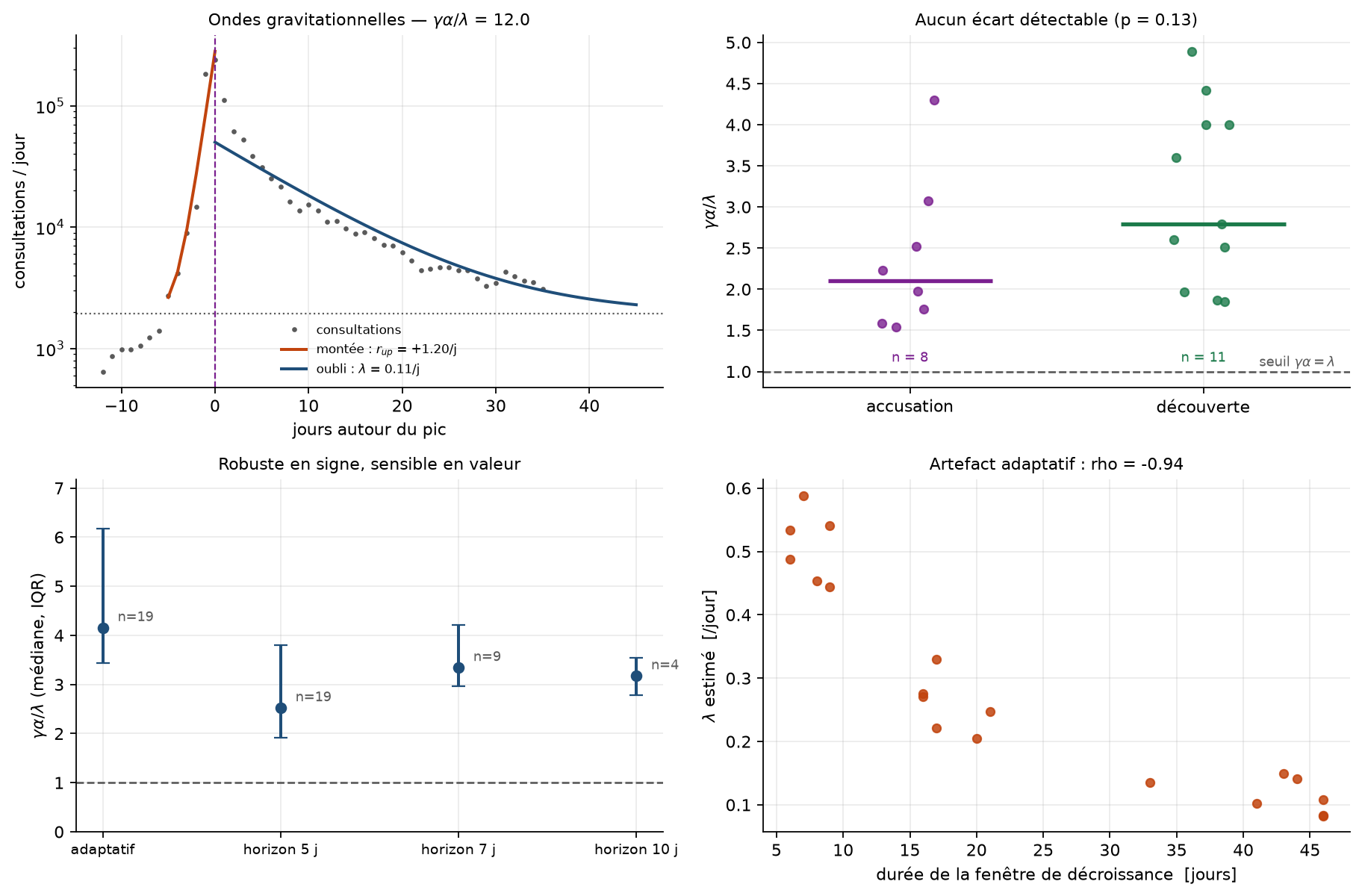
One episode close up; the ratio distribution by class; sensitivity of the median to the estimator; and the artefact that forced the second estimator. Figure regenerated by notebook 09.
| Estimator | n | median | IQR | range | p (accusation vs discovery) |
|---|---|---|---|---|---|
| adaptive | 19 | 4.16 | [3.44, 6.17] | [2.01, 12.01] | 0.48 |
| fixed 5 d | 19 | 2.52 | [1.92, 3.80] | [1.54, 4.89] | 0.13 |
| fixed 7 d | 9 | 3.34 | [2.97, 4.21] | [1.81, 6.28] | 0.56 |
| fixed 10 d | 4 | 3.18 | [2.78, 3.54] | [2.47, 3.78] | 0.67 |
1. The sign criterion is empty
The ratio exceeds 1 everywhere — and this follows logically: by construction, an observable attention episode went through a growth phase, so \(r_{\text{up}} > 0\), so \(\gamma\alpha > \lambda\).
Consequence for the memorandum. "Prohibit configurations where \(\gamma\alpha > \lambda\)" is inapplicable as written: the condition holds for any content that broke through. What a regulator can constrain is a ceiling on the ratio — and this measurement provides the reference from which such a ceiling can be argued.
A negative result on the formulation, and a positive one for the method: without the measurement, the error would have made it into a regulatory text.
2. The value is method-sensitive, the sign is not
The median varies by a factor of 1.7 across estimators. Any quoted value must come with its estimator, and a regulatory threshold anchored to a single number would be contestable.
3. The window artefact, and its correction
With windows bounded by the return to baseline, their length ranges from 6 to 46 days. Since attention does not decay exactly exponentially — its tail is heavier — a fit over a long window captures that tail and yields a smaller \(\lambda\). The measured rank correlation is −0.94: \(\lambda\) was essentially determined by window length, not by the subject.
The fixed-horizon estimator forces both windows to the same length. \(\lambda\) becomes "the mean forgetting rate over the first \(H\) days after the peak", comparable across episodes. The cost is rejecting episodes too brief to cover the horizon — hence the falling sample size as \(H\) grows.
4. The emotional-charge mechanism is not supported
No estimator produces a detectable difference between classes (\(p \geq 0.13\)), and the point estimate goes in the opposite direction to the prediction: the discovery class has a slightly higher median.
It would be dishonest to call this a refutation: sample sizes are tiny, the selection bias described below excludes the most emotionally charged cases, and Wikipedia is not where the mechanism is supposed to operate. But it would be equally dishonest to present the mechanism as data-supported. It is not.
The heaviest limitation: the method is blind to installed regimes
Eleven of twenty-four subjects yielded no exploitable episode — and for the accusation class these are the archetypal cases: QAnon, COVID-19 misinformation, vaccine hesitancy, the Great Replacement, Pegasus.
The reason is structural. These subjects do not produce a spike followed by decay: their attention shifts regime and settles onto a durable plateau. The rolling baseline follows that plateau, so the prominence criterion is never met. The method does not reject them — it does not see them.
This is a first-order limitation: the procedure selects against the very phenomenon the theory is about. A test verifies it explicitly on a synthetic regime shift, so that the limitation cannot be forgotten.
The second dominant rejection reason is the window being too short: many episodes rise in one or two days, which cannot be fitted on daily data.
What this opens up
- Regime-change detection rather than peak detection, to reach durable-installation dynamics — the case that matters most and escapes this analysis entirely.
- Sub-daily resolution, to make brief episodes identifiable.
- Non-exponential decay — fitting a power law or a sum of two exponentials would remove the window artefact rather than work around it.
- A source with a recommender algorithm, the only route to a platform-level \(\gamma\) rather than an ecosystem gain: this is what DSA Article 40 data access is for. The present measurement is the case that makes such a request credible.
Reproduce
# The cache is versioned; this step is only needed to refresh it.
docker compose run --rm lab python scripts/fetch_pageviews.py

docker compose run --rm notebooks jupyter nbconvert --to notebook --execute --inplace \
  notebooks/09_calibration_visibilite.ipynb
Implementation: ide.calibration, ide.pageviews, ide.corpus · Notebook:
09 — Calibration ·
roadmap